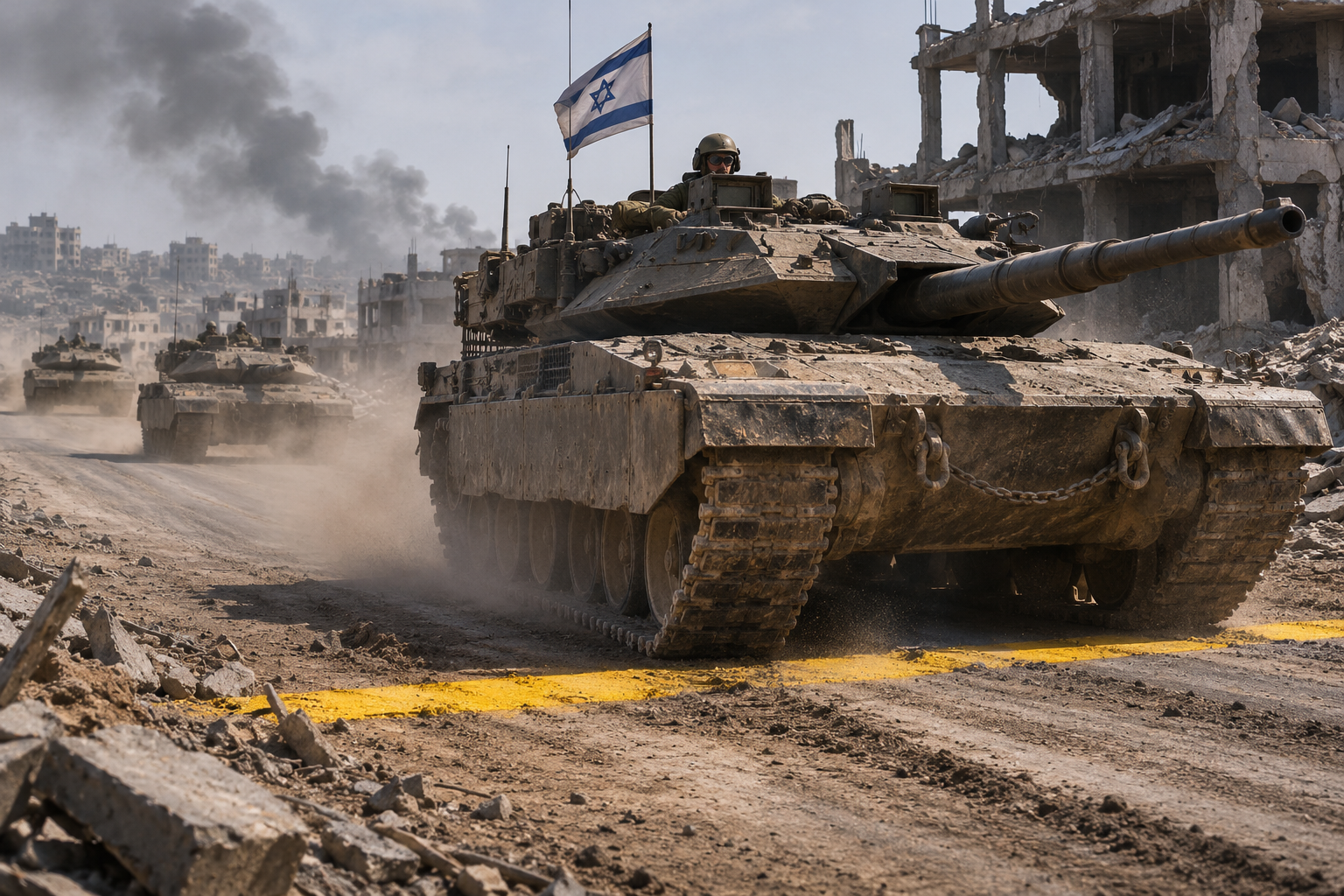
Israeli Tanks Cross Gaza Ceasefire Boundary in First Ground Operation Since Deal
A ceasefire boundary matters only while both sides treat it as a boundary. Israeli tanks crossing Gaza’s “yellow line” for the first reported ground operation beyond it since last October’s deal has put that premise under direct strain.
The operation unfolded along the Salah al-Din road, Gaza’s main north-south route, in Hamas-controlled central Gaza. Dozens of displaced Palestinians fled their tents, according to the Guardian. Israel says it moved to dismantle a “terror tunnel”; Hamas calls the move a “flagrant” violation of the ceasefire.
This is the ceasefire’s line test: can a ground incursion remain a contested exception, or does it redraw the military boundary in practice?
The crossing changed the argument
The yellow line had been the practical marker of the ceasefire’s military geography. Crossing it does not, on its own, prove the agreement has ended. It does turn a dispute over terms into an event on the ground.
That matters because the issue is no longer only whether Israel had a security rationale. It is whether the deal permitted a ground operation beyond the line, and who had authority to judge that before or after it occurred.
A limited operation followed by a return to the prior position would carry different implications from repeated crossings. The boundary’s meaning now depends on what happens next, not on the name given to this operation.
Two accounts, one unresolved threshold
Israel’s account is narrow: its forces acted to dismantle a tunnel. Hamas’s is categorical: the operation breached the agreement.
BBC News independently reported that the Israeli military completed a ground operation beyond the Yellow Line, confirming the core event and recording both the tunnel rationale and Hamas’s condemnation.
But the central threshold remains unverified in public reporting. There is no independent evidence yet establishing the tunnel’s existence, the operation’s full duration, or whether the ceasefire oversight structure authorized, objected to, or was informed of the move.
The Board of Peace now faces the line test
The US-backed Board of Peace, which oversees the ceasefire, had accused both Israel and Hamas the day before the operation of failing to honor commitments to end hostilities.
Its next public statement is the most important immediate checkpoint. It could indicate whether the crossing was a breach, a disputed exception, or evidence that the agreement never clearly defined what operations beyond the line allow.
The evidence to watch is concrete:
- Whether Israeli forces remain beyond, or return behind, the yellow line. - Whether evidence emerges for the stated tunnel objective. - Whether the Board of Peace publicly defines the operation’s status under the ceasefire.
For now, the incursion is not proof that the ceasefire is finished. It is proof that its most visible boundary has become negotiable under pressure.