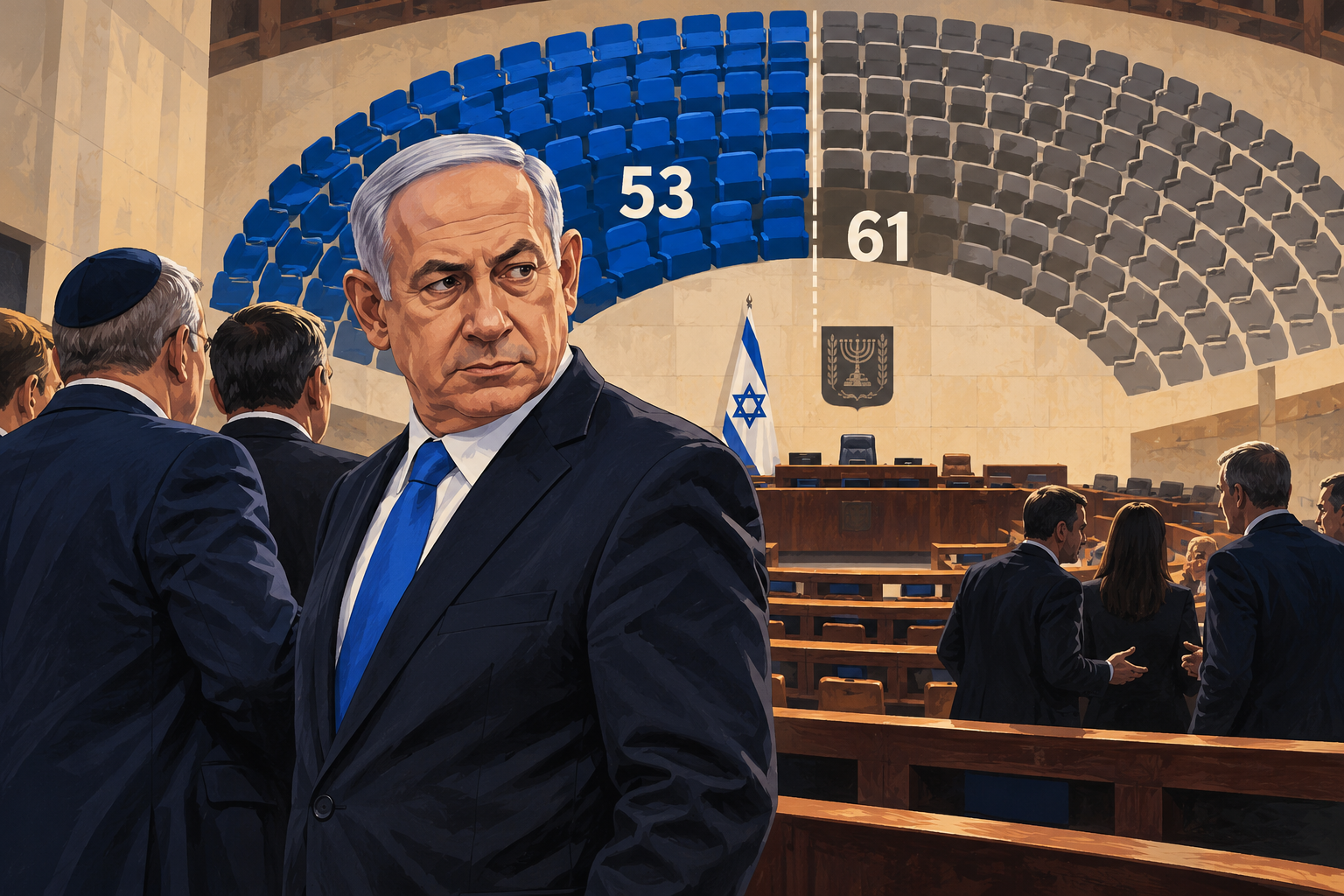
Netanyahu’s Bloc Leads Israel’s Election—but 53 Seats Leaves Coalition Talks Decisive
Netanyahu’s bloc may be leading Israel’s election, but 53 seats cannot form a government.
With 93% of ballots counted, Benjamin Netanyahu’s Likud party and its allies are projected to win 53 of the Knesset’s 120 seats. That puts the bloc eight seats below the 61 needed for a majority—and makes coalition negotiations, not the current tally, the decisive contest.
A Lead Without a Mandate
The partial result establishes an electoral advantage, not a governing mandate.
A 53-seat bloc gives Netanyahu a starting position in negotiations and keeps a return to power possible. But it does not let Likud and its existing allies govern alone. The remaining ballots and final allocation matter because small seat shifts can change which partners become indispensable.
For now, the confirmed distinction is simple: Netanyahu’s side leads the count; it has not secured control of the next government.
The 53-Seat Constraint
Israel’s parliamentary arithmetic creates a hard threshold. A coalition needs at least 61 seats to command a majority in the Knesset.
That means Netanyahu must either attract support from outside the projected alliance or find a way to reshape the coalition map. The relevant measure is no longer only party performance at the polls. It is whether potential partners make commitments that move the bloc from 53 to 61.
This is the election’s governing constraint: a lead is politically meaningful, but it is not self-executing.
Why the Opposition Has No Easy Route
Netanyahu’s shortfall does not automatically hand power to the opposition.
The Guardian reported a surge in votes for Palestinian parties in a tightly contested, high-turnout election. Yet several Jewish opposition parties have ruled out governing with Palestinian-led parties. If those positions hold, the opposition may face its own gap between numerical strength and a workable governing coalition.
That leaves both sides confronting a coalition test, though from different starting points: Netanyahu must gain seats or partners; his rivals must decide whether their stated political boundaries prevent them from assembling an alternative.
Commitments, Not Projections, Settle the Result
The next phase can be tracked through a simple sequence: seats, commitments, government.
Final results will determine the completed Knesset allocation. Then public coalition statements, negotiation agreements, and support pledges will show whether either bloc can cross the 61-seat line.
Until those commitments emerge, the most defensible conclusion is narrow: Netanyahu’s bloc is ahead, but Israel’s governing outcome remains open.