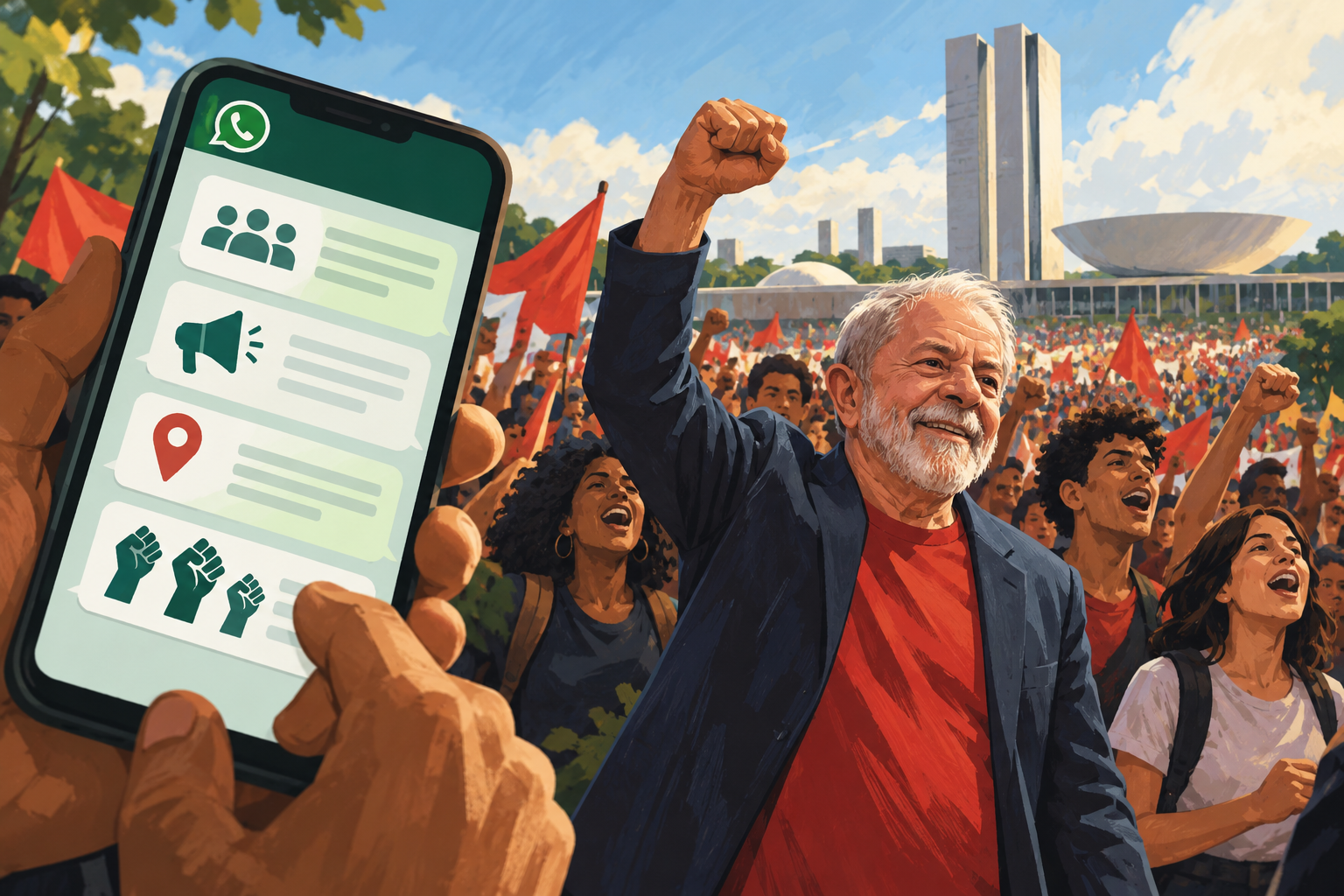
Lula’s WhatsApp Campaign Turned Online Energy Into Election Mobilization
Lula’s comeback was not simply a victory of reach. It was a victory of conversion: turning millions of people in a WhatsApp channel into activity that could travel beyond a phone screen.
That distinction matters. Reporting on Brazil’s election points to “Lula’s Army,” a viral WhatsApp channel, as part of a broader machine that helped transform online enthusiasm into real-world mobilisation. The campaign did not just broadcast support; it appears to have created a route from attention to participation.
The runoff started with a hard electoral problem
After the first round, Lula had finished second. The Guardian reported that many analysts expected the roughly 9 million voters who backed other candidates—all on the right—to shift largely toward Senator Flávio Bolsonaro.
That made a Lula victory look difficult. A conventional social-media explanation—more posts, more followers, more visibility—does not fully account for the reported reversal.
The more specific explanation is that Lula’s campaign built a mobilization bridge. Digital channels could circulate messages quickly, but their electoral value depended on whether supporters then recruited others, joined events, protested, persuaded undecided voters, or showed up to vote.
“Lula’s Army” made participation easier to organize
The BBC reported that millions joined the “Lula’s Army” WhatsApp channel and that it helped move online enthusiasm into real-world mobilisation.
A large channel alone is not a political advantage. It can be a passive audience, a supporter list, or simply a signal of existing momentum. Its value rises when it reduces the friction between a campaign request and a supporter’s next action.
That is the relevant signal here:
- A message reaches supporters directly. - Supporters receive a concrete instruction or social proof. - Activity becomes visible beyond the platform. - That visibility creates more recruitment, conversation, and turnout pressure.
WhatsApp’s role, in this account, was not generic “social media influence.” It was an organizing layer: a way to coordinate many small acts of political participation at speed.
Street protests turned network energy into public proof
The Guardian’s reporting places the channel alongside student-led protests. That pairing is important because it suggests a cumulative system rather than a single-platform win.
Digital networks can coordinate attention. Streets can make that attention tangible. A protest can signal that a campaign has energy, give supporters an event to join, generate material for further sharing, and change the perceived direction of a race.
The channel and the protests may therefore have reinforced each other: online messages helped direct people toward collective action, while visible collective action made the digital movement feel more credible and urgent.
The attribution test is still demanding
The reporting supports a narrow but meaningful claim: Lula’s campaign used a viral WhatsApp network to help convert support into offline political activity.
It does not establish that the channel independently caused the election result. The runoff could also reflect voter transfers, Flávio Bolsonaro’s weaknesses, broader anti-Bolsonaro sentiment, campaign operations outside WhatsApp, and the protests themselves.
The clearest test is whether Lula’s runoff gains align with evidence of actual local mobilization: channel membership by region, message archives, event participation, volunteer activity, and turnout changes. Until that evidence is measured, WhatsApp should be treated as a reported organizing mechanism—not a complete explanation for the outcome.