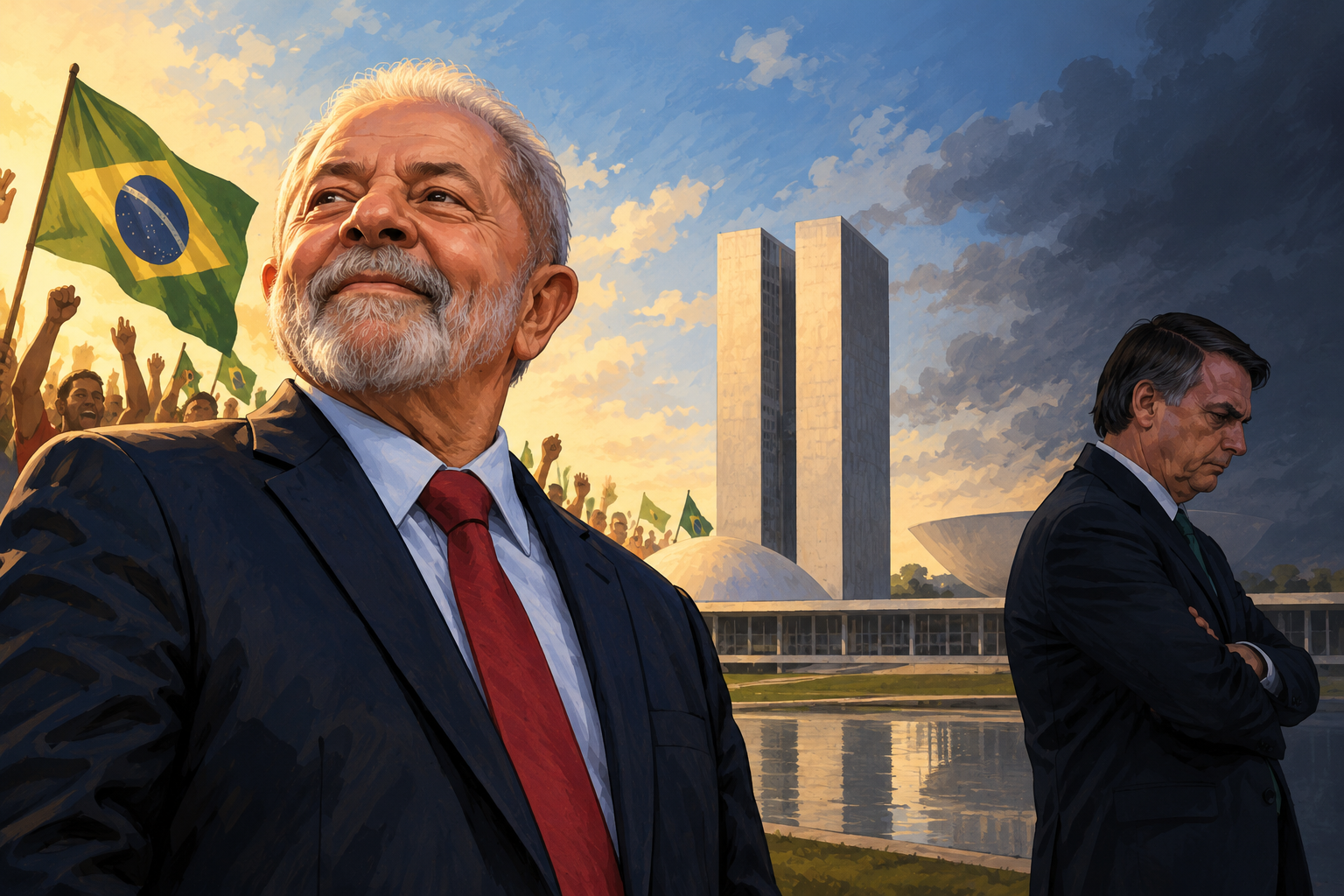
Lula Wins Brazil’s Presidency as Bolsonaro Rejects the Result
Brazil has a declared winner, but not yet a settled post-election reality.
Brazil’s electoral court said Luiz Inácio Lula da Silva held an insurmountable lead after 100% of votes were counted, securing his fourth, non-consecutive term as president. Flávio Bolsonaro rejected the result. The vote is official; the immediate question is whether that rejection becomes more than a statement.
Lula’s Return Is a Confirmed Electoral Result
The court’s announcement closes the counting process: Lula won the runoff and will return to Brazil’s presidency for a fourth term.
The result is historically significant. Lula is the first candidate since Brazil resumed direct elections in 1989 to lose the first round and then win the final runoff, according to CNBC.
It also interrupts a run of conservative electoral victories in Latin America, giving Lula’s return regional weight beyond Brazil’s domestic contest.
The Count Is Complete, but Acceptance Is Not
Flávio Bolsonaro’s rejection does not change the tally. But it creates a gap between legal finality and political acceptance.
That gap is where the story now sits. An election result can be certified and still face pressure through court filings, public mobilization, administrative obstruction, or efforts to cast doubt on the institutions that delivered it.
For now, the source pack establishes rejection, not a defined mechanism for reversing the outcome. That distinction matters. The uncertainty is about the response to Lula’s win—not about whether the vote count produced a winner.
Decision, Enforcement, Response
The next phase can be read through a simple constraint: decision, enforcement, response.
Brazil’s electoral court has made the decision. The test of enforcement is whether institutions continue to treat the result as binding. The response is whether Bolsonaro’s camp pursues an official challenge or turns rejection into broader political action.
A separate election-day episode shows why institutional follow-through will draw scrutiny. A local electoral court ordered the immediate restoration of a city’s full bus fleet and issued an arrest warrant for municipal transport secretary Pablo Souza over suspected electoral offenses and failure to comply with court orders, according to The Guardian. The warrant had not been carried out because Souza was reported to be in Paris.
That does not establish a national challenge to the presidential result. It does underline that election administration and court authority remain part of the post-vote environment.
International Recognition Is Moving Faster Than Domestic Closure
World leaders have begun congratulating Lula, signaling that foreign governments are treating his victory as legitimate and operative.
International recognition cannot settle Brazil’s internal political dispute. But it narrows the external ambiguity: other governments are responding to Lula as president-elect while Brazil’s domestic actors determine whether the rejection produces a concrete institutional confrontation.
Lula has the mandate. Whether Brazil gets a clean transition now depends less on another count than on what Bolsonaro’s rejection actually becomes.