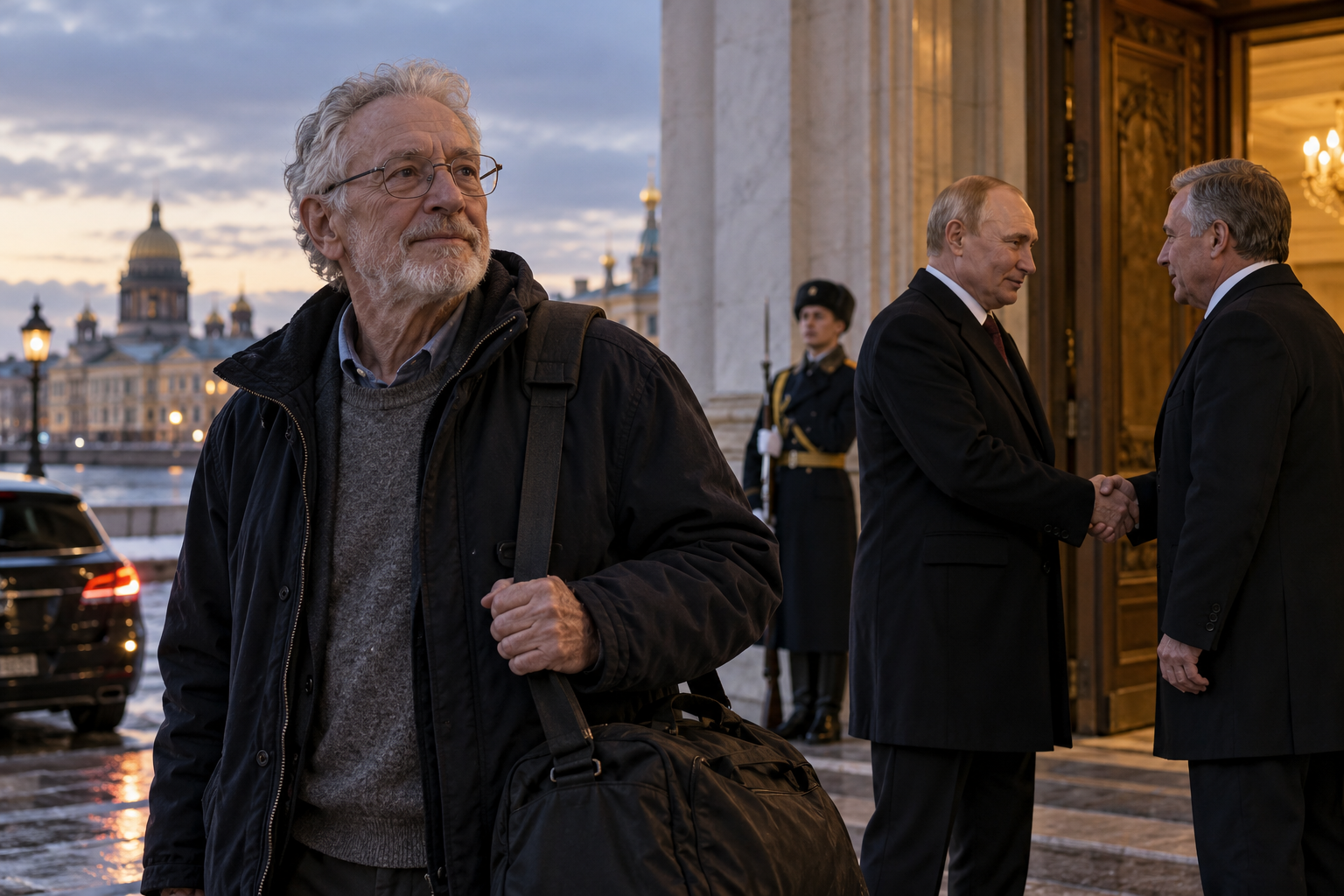
Russia Releases Stephen Hubbard as Putin Meets Trump Envoy
Russia released American citizen Stephen Hubbard as Vladimir Putin met U.S. envoy Steve Witkoff in St. Petersburg for talks on ending the war in Ukraine.
That is a confirmed, tangible development. But it is not yet evidence of a diplomatic breakthrough. Hubbard’s release matters because it places a concrete concession beside renewed U.S.-Russia engagement; its larger meaning depends on what the meeting produces next.
Hubbard’s Release Is the Concrete Result
Hubbard, a 74-year-old former teacher, had spent more than four years in Russian custody after being charged with fighting as a mercenary for Ukraine, according to The Guardian.
Donald Trump had requested his release. Russia freed him as Witkoff began talks with Putin, a timing reported across NPR, CBS News, The Guardian, and BBC News.
That overlap makes the release more than a standalone consular event. It is the clearest observable outcome attached to a meeting centered on the Ukraine war.
Ukraine Is Back at the Center of the Conversation
The Putin-Witkoff meeting was focused on efforts to end the war in Ukraine. Hubbard’s release can reasonably be read as a diplomatic gesture in that setting, but the reports do not establish what Russia received, promised, or discussed in exchange.
That distinction matters. Prisoner releases can lower friction and create political room for talks without resolving the core issues that have blocked negotiations.
The immediate signal is renewed contact. The unproven claim would be renewed alignment.
Russia’s Resume-Talks Signal Needs a Deliverable
BBC News reported that Russia said it was ready to resume talks with Ukraine and the United States following the Putin-Witkoff meeting. NPR similarly placed Hubbard’s release announcement as the talks got underway.
Together, those reports support a narrower conclusion: Moscow and Washington are again discussing an active negotiating agenda around Ukraine.
They do not confirm an agreement, a timetable, or a shared set of terms. Readiness to talk is a position; resumed talks with defined participants and dates would be an action.
The Follow-Through Test
The story now runs through a simple test: claim, countermove, verification.
Russia’s claim is that it is prepared to resume diplomacy. Hubbard’s release is a countermove that gives that claim some weight. Verification requires evidence beyond the meeting itself.
Watch for an official account of the Putin-Witkoff discussion, a confirmed plan for resumed negotiations involving Ukraine, or another concrete action that changes the diplomatic landscape.
Until then, Hubbard’s release is significant precisely because it is real. The broader settlement narrative remains conditional.