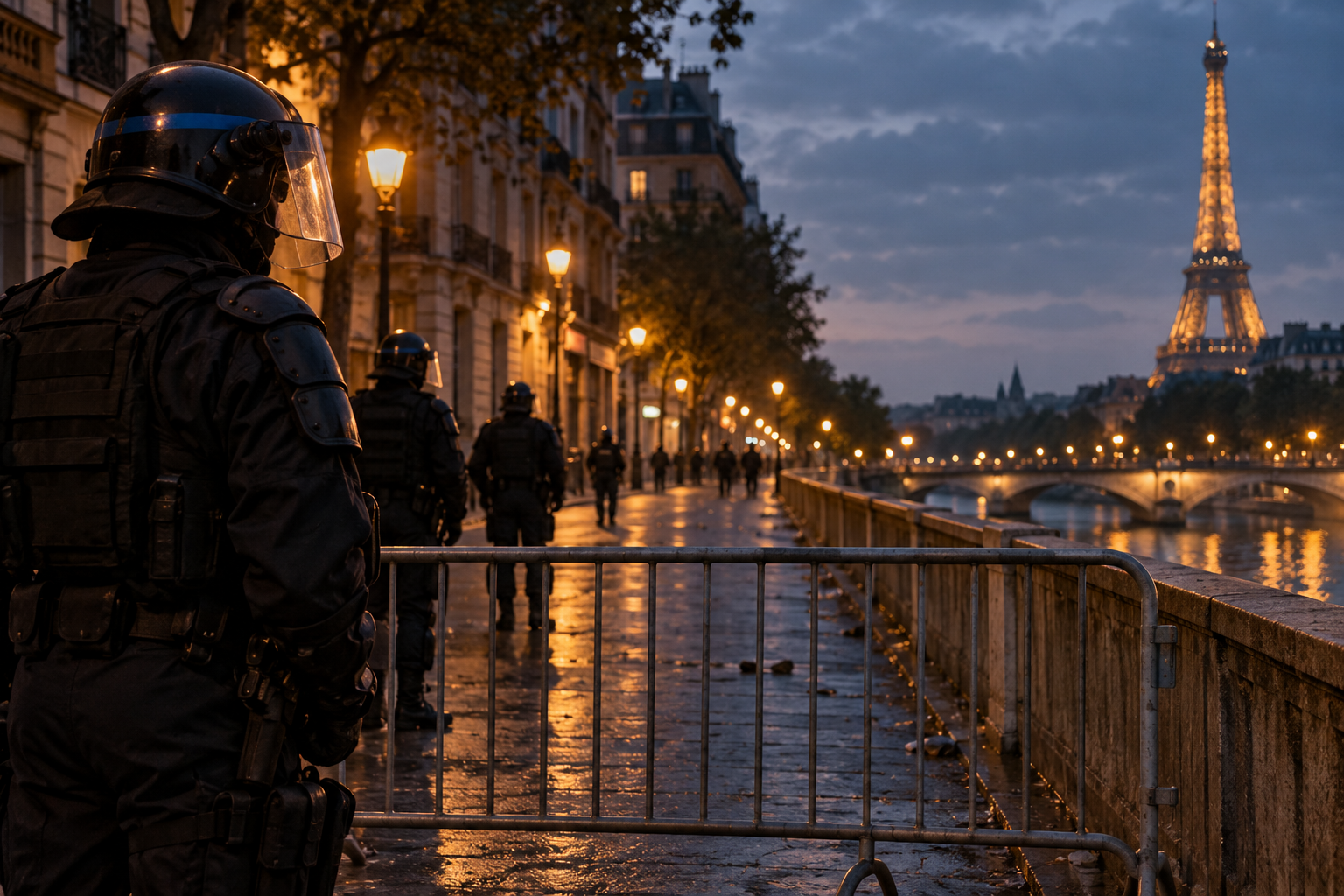
France Expands Curfews After Weekend Riots and Mass Arrests
France is no longer just responding to weekend riots. It is restricting movement.
After violence caused extensive damage and thousands of arrests, the government imposed partial curfews in several cities, including parts of Paris. The shift follows the interior minister’s admission that police had “lost control” during the protests.
Prime Minister Sébastien Lecornu has rejected citywide closures. That makes these curfews a narrower but consequential bet: France must show it can restore order block by block without locking down entire cities.
The State Has Changed Its Posture
The immediate fact is not simply that curfews exist. It is what they require.
A police response to a protest focuses on dispersing crowds and responding to damage. A curfew sets a broader rule over public movement, then asks authorities to enforce it across designated areas and hours.
Lecornu said he is “fully resolved to restore public order” and called for local, partial curfews where needed. The government’s response has therefore moved beyond managing a weekend of unrest toward controlling the conditions in which it could recur.
The Precision Test
France’s policy has one hard constraint: it must be precise enough to work.
The government has imposed restrictions in several cities and parts of Paris while ruling out a full curfew across entire cities. That approach depends on three things working together:
- Residents need to know where the curfew applies and when. - Police need the capacity to apply the rule consistently. - Restricted areas need to show a visible reduction in violence and damage.
This is the precision test. A partial curfew can limit disruption outside the most affected areas, but only if its boundaries and enforcement are clear enough to change behavior.
Why the Admission Matters
The interior minister’s acknowledgment that police lost control raises the stakes of the announcement.
The curfews are now an attempt to reassert authority after a public enforcement failure, not merely a precaution against possible disorder. Lecornu’s pledge to restore order will be measured against conditions in the restricted areas, not against the force of the language used at the emergency cabinet meeting.
A calmer night in those areas would support the case that targeted measures can contain the unrest. Continued violence despite the new restrictions would expose the gap between announcing control and exercising it.
The First Evidence Will Come From the Curfew Zones
The next meaningful checkpoint is straightforward: what happens after the restrictions begin in the cities and Paris districts covered by them?
Watch for verified reports of violence, damage, and arrests in those areas, alongside the practical details of the curfew rules—who is covered, during which hours, and how authorities enforce them.
France has chosen local limits over a citywide shutdown. The first nights under curfew will show whether that restraint is a sign of control or the limit of it.