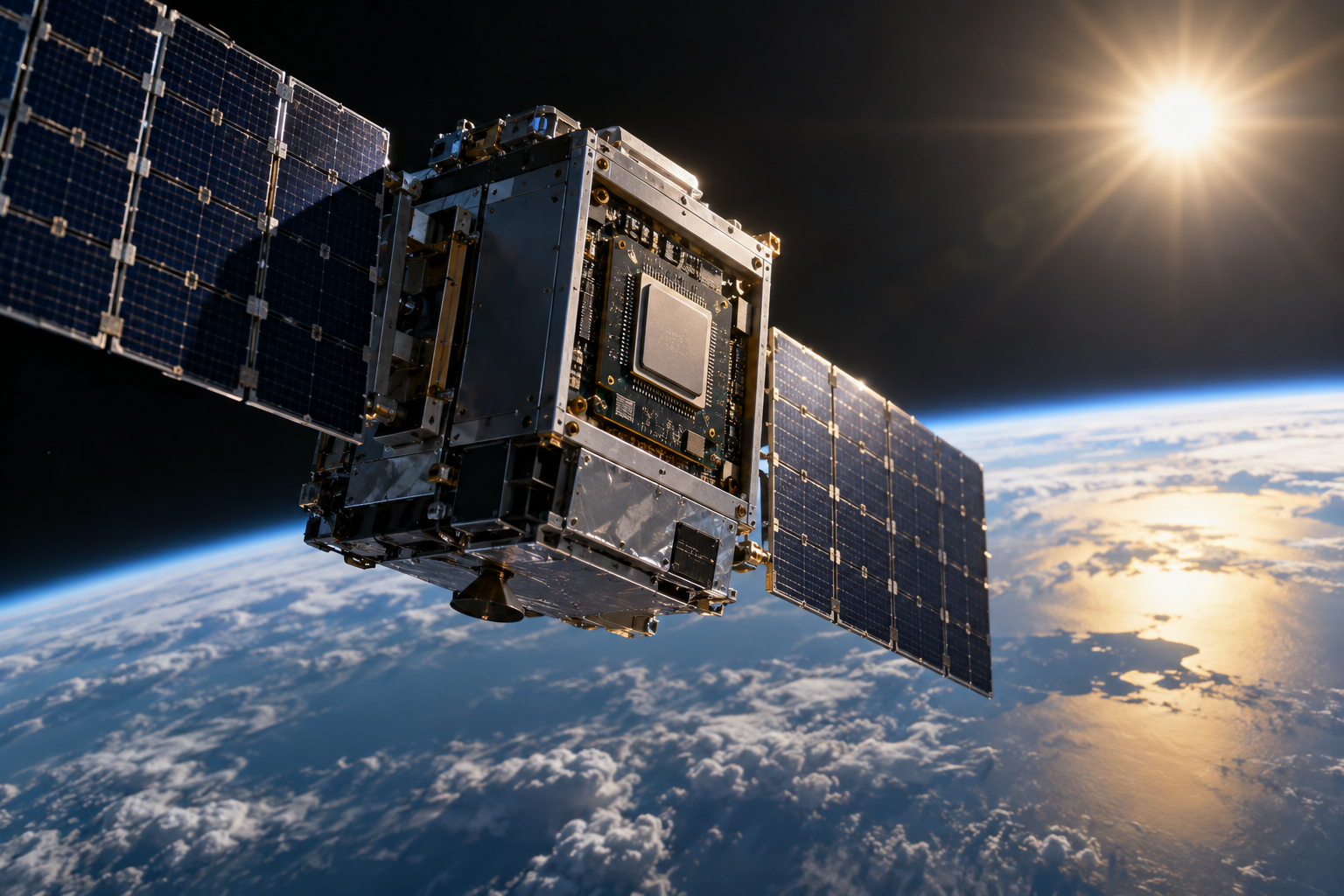
Google Puts AI Chips in Orbit for Project Suncatcher
Google’s AI chips are now in orbit, but the launch is evidence of an early Project Suncatcher step—not proof that space-based data centers are ready.
Google tensor processing units launched aboard Planet Labs satellites, moving its Suncatcher moonshot from a concept into a physical technology test. The ambition is large: run AI computing in space and draw on solar energy. The confirmed milestone, however, is much narrower. Hardware has launched; an operational orbital data center has not.
Google Has Put Hardware Behind the Suncatcher Bet
Putting TPUs on satellites gives Google a chance to test computing equipment in the conditions that would define any future orbital infrastructure.
That matters because Project Suncatcher is no longer solely a long-range thesis about abundant solar energy beyond Earth’s atmosphere. Google can now gather evidence on whether specialized AI hardware can operate reliably in orbit and how it performs within a satellite-based system.
But launch status should not be confused with service status. The available reporting does not establish that Google is running production AI workloads in space, offering customer access, or operating a distributed compute platform.
A Chip in Orbit Is Not a Data Center in Orbit
A functioning data center is more than a processor attached to a satellite. It needs sustained power, heat management, communications, networking, redundancy, maintenance plans, and enough capacity to justify the cost of getting hardware into orbit.
Those requirements create the core test for Suncatcher: can an orbital system alter a meaningful constraint in AI computing—energy availability, cost, capacity, or competitive access—rather than simply prove that a chip can survive in space?
The project’s solar-energy premise is compelling in theory. Its commercial case remains unproven until Google shows the full operating system around the chip: how compute nodes connect, how workloads move in and out, how hardware is managed, and what the economics look like at scale.
The 1,800-Launch Constraint
TechCrunch reported that Google estimates SpaceX’s Starship would need roughly 1,800 launches before space data centers could get off the ground.
That figure turns Suncatcher into a deployment and capital question as much as an AI-chip question. Even a successful orbital test would be only one component of an infrastructure buildout dependent on frequent, reliable, high-volume launch capacity.
The constraint is straightforward: a technology demonstration can validate a component, while a commercial system must validate the supply chain that puts thousands of components into position and keeps them working.
The Evidence That Would Change the Story
The next meaningful evidence would be technical results from the chips in orbit: performance, reliability, power use, thermal behavior, and communications under space-specific conditions.
Google would also need to describe a credible architecture for connecting individual satellites into a usable compute system. A satellite carrying a TPU is a test asset; a network that can accept workloads reliably is a platform.
Finally, adoption would matter. Customer commitments, developer access, or strategic partners using the system would indicate demand beyond an internal moonshot.
Project Suncatcher has crossed an important boundary: Google has put hardware behind its claim. It has not yet crossed the harder boundary of showing that orbital AI computing can become an operating business.