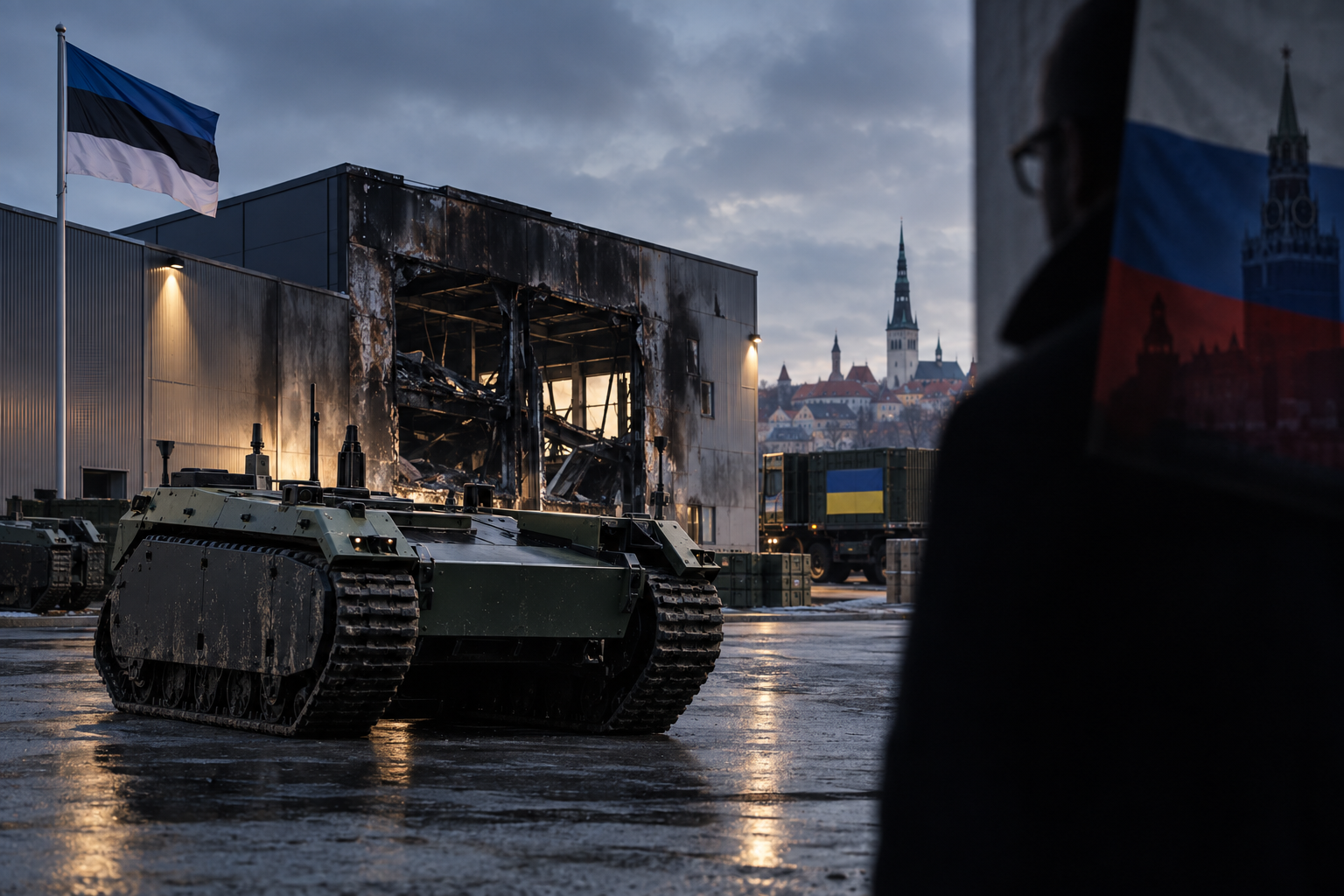
Estonia Accuses Russia of Ordering Milrem Robotics Arson
Estonia says Russian special services ordered the August arson at Milrem Robotics, a Tallinn defence company whose unmanned ground vehicles are supplied to Ukraine. That turns a fire at a manufacturer into an allegation of state-directed sabotage inside NATO territory.
The accusation is serious. It is not yet publicly proven. Russia denies involvement, and Tallinn has not disclosed the intelligence, forensic evidence, suspects, or command chain behind its attribution.
The Tallinn Fire Has Crossed a Proof Threshold
Prime Minister Kristen Michal said the attack on Milrem Robotics was ordered by Russian special services and said Estonia would not be intimidated.
That claim changes the stakes. A conventional criminal investigation asks who set a fire. Estonia’s account raises a second question: who commissioned it, and can that direction be documented well enough to support diplomatic, legal, or security consequences?
For now, the confirmed development is Estonia’s public attribution and Russia’s denial—not a verified public account of the operation.
Why Milrem Is More Than a Local Manufacturer
Milrem’s role supplying unmanned ground vehicles to Ukraine connects its Tallinn operations to the wider war effort.
If a Ukraine-linked defence supplier was deliberately targeted, the alleged attack would signal pressure on the industrial infrastructure behind European military support, not just on Ukraine itself. That is why the case matters beyond the immediate damage from the August fire.
It also puts a sharper boundary around a growing security concern: commercial companies supporting Ukraine may become targets even when they operate far from the battlefield.
Tallinn Has Moved Diplomatically
Foreign Minister Margus Tsahkna called the attack “absolutely unacceptable” and said Russia’s chargé d’affaires in Tallinn would be summoned.
That is a concrete response, but it is a diplomatic one. It demonstrates that Estonia treats the attribution as consequential without yet making the underlying case available for public examination.
European and NATO leaders have expressed support for Estonia and Ukraine, according to reporting by the Guardian. Support reinforces the political weight of Tallinn’s allegation; it does not independently establish who ordered the arson.
Regional Pressure Is Context, Not Confirmation
The accusation lands amid broader warnings of alleged Russian sabotage activity in European NATO countries that support Ukraine. Recent drone incidents along NATO’s eastern flank have also prompted discussion of stronger integrated air and missile defence.
That backdrop helps explain why Estonia sees the Milrem fire as part of an evolving threat environment. But a regional pattern is not case-level proof. The connection between the fire and Russian services still depends on evidence specific to Milrem.
Three Tests Will Determine Whether the Claim Holds
The case now follows a simple sequence: claim, countermove, verification.
First, Estonia would need to disclose evidence that links the fire to Russian direction rather than only asserting responsibility. Second, independent reporting or investigative findings would need to corroborate—or challenge—the official account. Third, further legal, diplomatic, or security measures would show whether officials consider the attribution actionable.
Until those tests are met, the durable fact is narrower but still significant: Estonia has accused Russia of commissioning sabotage against a defence supplier to Ukraine, and it has begun responding as though the allegation carries national-security consequences.