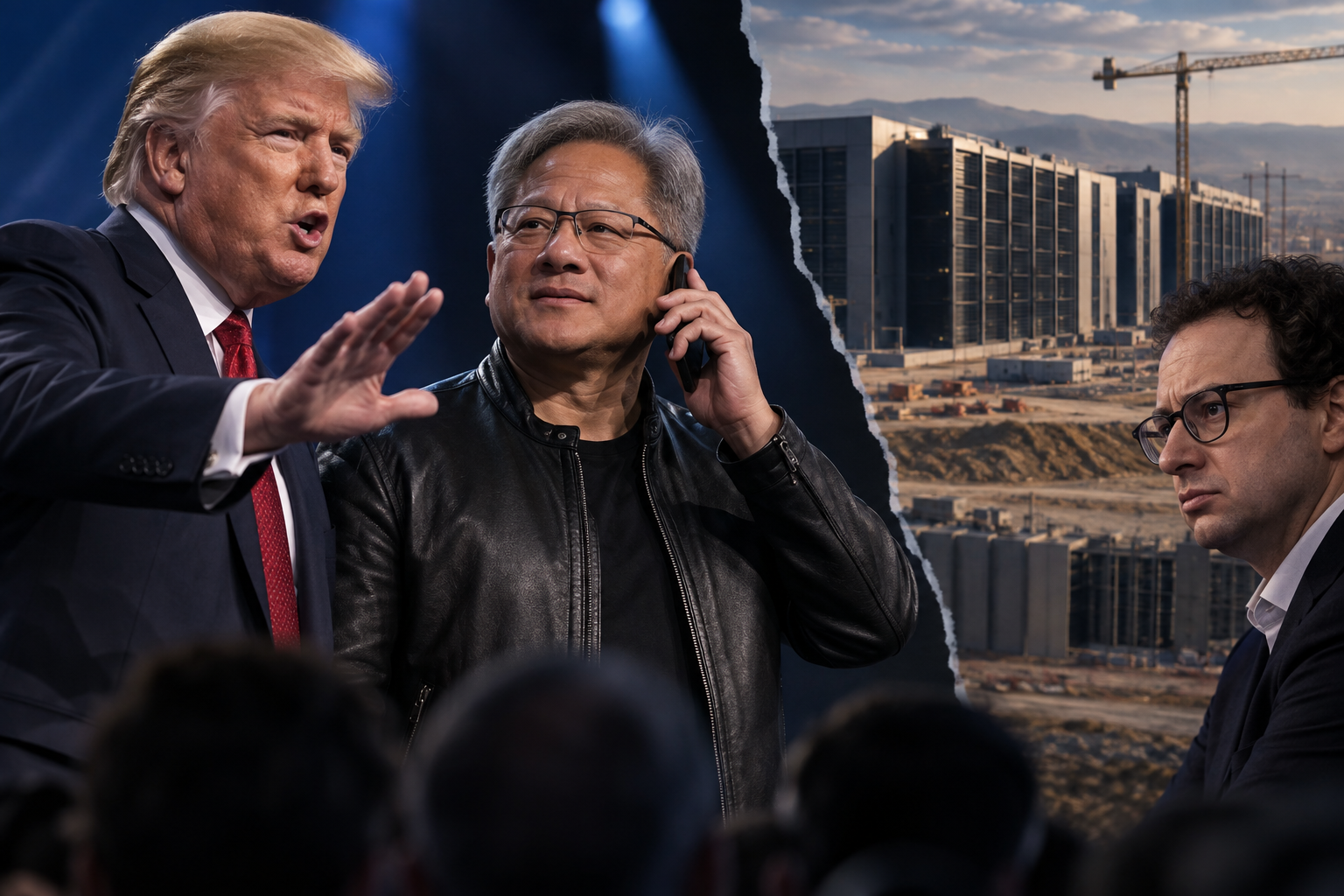
Trump Calls Data Center Opposition a “Hoax” as Huang Rejects an AI Slowdown
Trump and Nvidia CEO Jensen Huang have made their position plain: they oppose slowing AI development. What remains unclear is whether that alignment will change the physical constraints—power, permits, sites, and local consent—that determine how fast the industry can actually expand.
Washington and Nvidia Draw a Line Against an AI Pause
At the All-In Summit, President Donald Trump called opposition to data centers a “hoax” while criticizing Anthropic CEO Dario Amodei’s calls for the AI industry to slow down, according to CNBC.
Huang’s response was equally direct. The Nvidia chief told Trump, “we’re not going to let [an AI slowdown] happen,” as reported by TechCrunch.
That puts a public divide into unusually sharp relief. Amodei has argued for a slower pace; TechCrunch reported that Elon Musk and Sam Altman have supported that position. Trump and Huang instead presented continued expansion as the priority.
This is a conflict of positions, not yet a confirmed policy or industry shift.
The Speakerphone Moment Turned Alignment Into a Signal
The setting mattered. Huang took Trump’s call onstage at the All-In Summit, according to The Verge.
That turned a conversation between a president and the head of the company at the center of AI compute into a public display of alignment. Nvidia sells the chips that underpin much of the current AI buildout; Trump’s comments focused on resistance to the data centers needed to run and train these systems.
The appearance gave the dispute political visibility. It did not, based on the available reporting, announce a new federal rule, a data-center investment, or a change in Nvidia’s product plans.
The Constraint Is Capacity, Not Conviction
The immediate signal is about ambition. The consequential test is capacity.
AI expansion depends on more than executives and elected officials saying they want it to continue. Data centers require land, grid connections, generation capacity, capital, construction, permits, and community acceptance. Opposition to data centers can arise from those tangible pressures as much as from abstract arguments about AI safety.
A simple constraint test applies: rhetoric matters only when it changes the availability or cost of the inputs required to build.
Trump and Huang have supplied the rhetoric. The reporting does not establish whether additional power capacity, faster approvals, new facilities, or altered investment decisions will follow.
The Debate Becomes Material Only on the Ground
The next meaningful evidence would be specific: a policy action affecting permits or energy, a committed data-center investment, a revised deployment plan, or a customer and partner response that changes how AI infrastructure is bought or used.
Until then, the confirmed development is a high-profile disagreement over the pace of AI development. It shows that the argument over AI’s future is increasingly also an argument over infrastructure—but it does not yet show that the industry’s operating constraints have changed.