NASA’s Roman Telescope Begins Its Mission to Map the Hidden Universe
NASA has launched the Nancy Grace Roman Space Telescope, but the launch is only the starting gun. Roman’s significance will depend on whether its wide surveys produce evidence that changes how scientists measure dark matter, dark energy, and distant worlds.
The Launch Starts the Clock
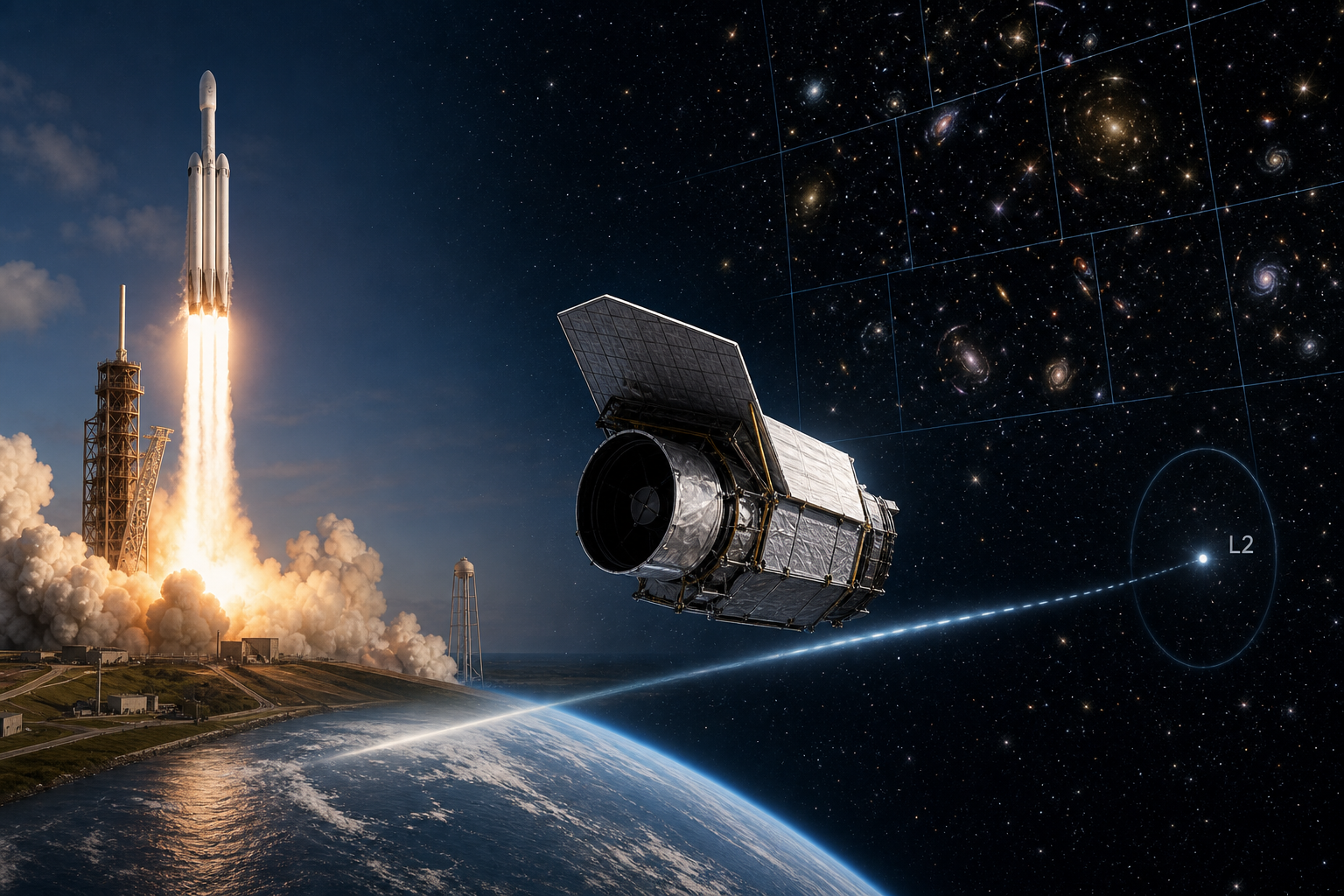
Roman launched aboard a SpaceX Falcon Heavy from NASA’s Kennedy Space Center in Florida on Aug. 30, 2026.
That confirms the mission has begun. It does not confirm a discovery, a usable dataset, or a scientific consequence. Launch images show that the observatory left Earth; they cannot yet show whether Roman will resolve any of the universe’s deepest open questions.
A Million Miles Before the First Answer
Roman is headed toward the Sun-Earth L2 region, roughly a million miles from Earth. Before its surveys can matter, the telescope must complete that journey and operate as intended.
That makes successful progress toward L2 the first practical checkpoint. A functioning observatory at its destination is the bridge between an ambitious mission design and evidence researchers can test.
A Survey Machine Built for Breadth
Roman’s promise is scale. Science Daily reports that it is designed to scan large portions of the cosmos at survey speeds roughly 1,000 times faster than Hubble.
NASA and ABC News describe a mission intended to observe billions of galaxies while investigating dark matter, dark energy, and distant worlds. Its advantage is not simply sharper imagery. It is the ability to collect broad, comparable observations across huge areas of sky.
That breadth could reveal patterns that smaller or narrower observations cannot establish: how galaxies are distributed, how cosmic structure changes over time, or how frequently certain distant planetary systems appear.
Capability Is Not a Discovery
The source pack supports the launch and the mission’s intended scope. It does not yet contain a Roman finding, public survey result, or independent assessment showing that a theory has changed.
That distinction matters. A larger survey can improve the odds of useful results, but volume alone is not scientific payoff. The relevant chain is:
Finding → validation → consequence
First, Roman needs a specific observation. Then researchers need to test it against other measurements and models. Only after that can anyone credibly say what the result changes for cosmology or planetary science.
The First Dataset Will Change the Story
The next meaningful Roman update is not another launch photograph. It is the first published survey result or public dataset that lets scientists examine what the telescope actually sees.
The central questions will be concrete: Do the observations sharpen constraints on dark matter or dark energy? Do they expose unexpected patterns in galaxy formation? Do they reveal populations of distant worlds that earlier surveys missed?
Roman is now on its way. Its lasting headline will be written when the surveys turn that journey into evidence.