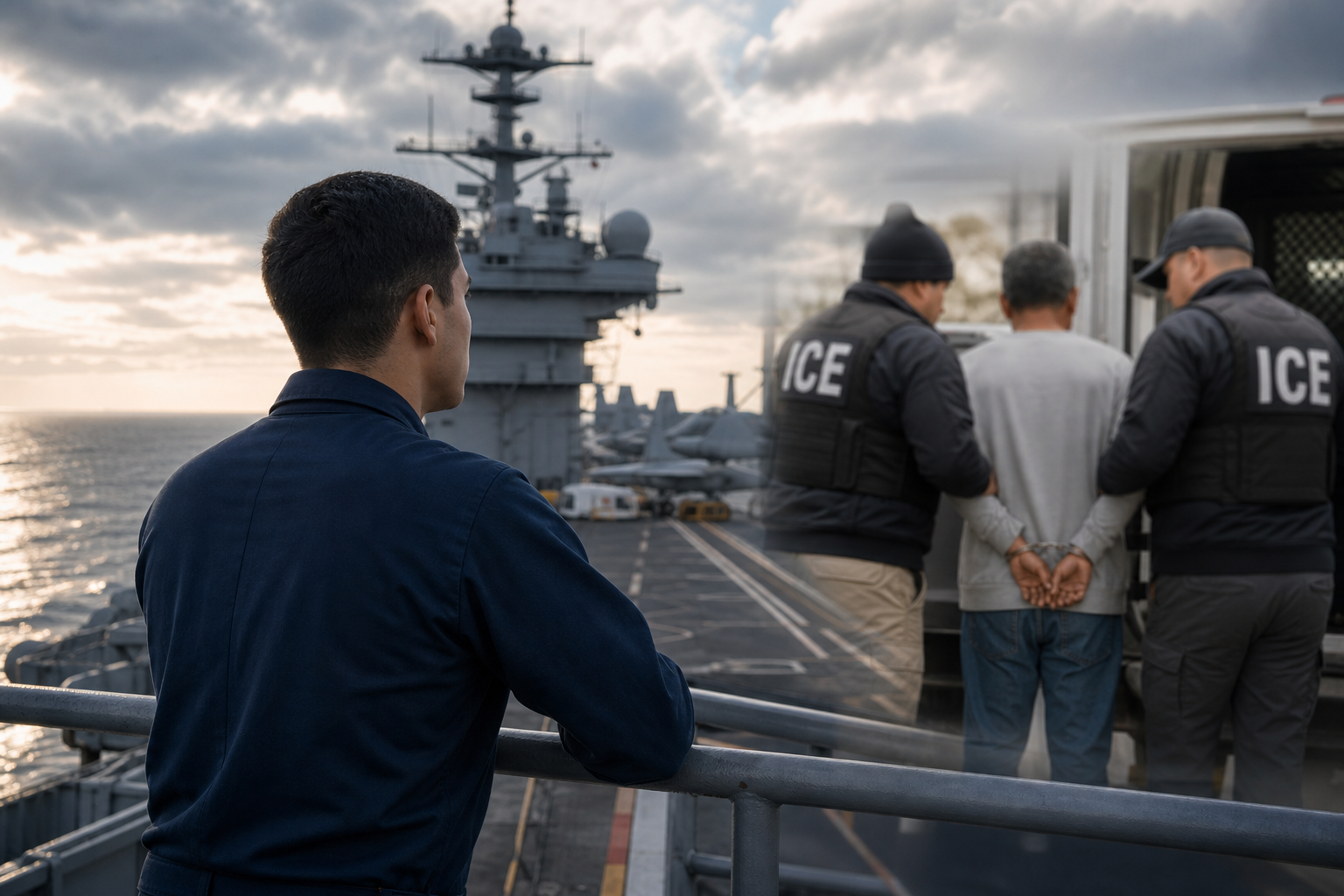
Navy Sailor Says His Father Was Arrested by ICE
Aboard the USS Abraham Lincoln, Joshua Aviles says he learned that federal immigration officials had arrested his father, Luis Manuel Aviles Roa. The account puts a family immigration case next to active-duty military service—but the public reporting still does not establish the arrest’s full circumstances.
That is the story’s central constraint: the claim is specific, personal, and publicly reported; the case file is not yet public.
From the carrier to the case file
Aviles’s account narrows the headline to one event: a sailor says his father was arrested by federal immigration officials.
The significance is not that military families receive a different immigration system. It is that an enforcement action can reach the immediate family of someone serving aboard a U.S. aircraft carrier, turning an individual case into a visible test of that tension.
For now, the available reporting supports Aviles’s and his family’s account. It does not publicly establish where the arrest occurred, what prompted it, or what happened afterward.
A case once described as unusual
CBS News reports that immigration arrests involving military spouses and parents were historically rare and have become more common under the second Trump administration.
That context gives the Aviles account broader weight. It does not prove that his father’s reported arrest reflects a particular policy or establish the scale of similar cases. It shows why this one is drawing attention: a family connection once seen as unusual is no longer outside the enforcement picture.
The facts still missing
The public account does not yet answer several basic questions:
- When and where was Aviles Roa reportedly arrested? - Which agency action occurred, and on what legal basis? - Is he detained, released, or involved in immigration or criminal proceedings? - Have ICE, the Navy, or the USS Abraham Lincoln made a documented statement?
Those are not minor details. They determine whether the headline remains a family’s reported account or becomes a fully documented account of a federal enforcement action.
The next checkpoint: a record, not another retelling
The next meaningful evidence is a court filing, detention record, or agency statement that identifies the date, location, legal basis, and current status of the case.
An ICE statement could clarify the reported action. A Navy response could clarify whether the service views it only as a private family matter or recognizes a wider concern for military families.
Until such a record appears, the clearest public fact is also the narrowest one: Joshua Aviles, serving aboard the USS Abraham Lincoln, says federal immigration officials arrested his father.