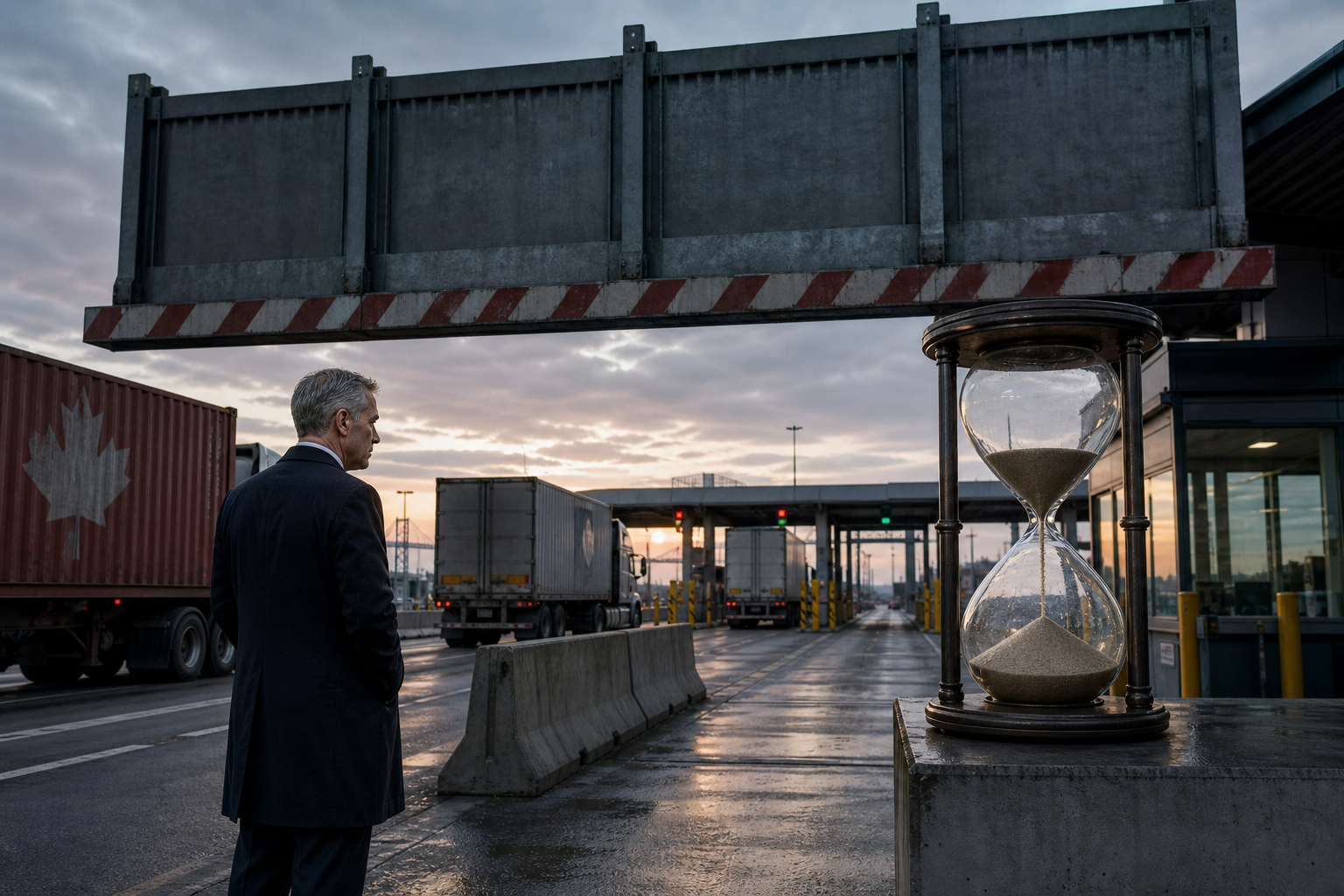
Trump’s 50% Canada Tariffs Put Carney Under Pressure
Trump’s Canada Tariff Deadline Turns Carney’s Options Into a Test
A 50% Tariff With a 30-Day Fuse
A tariff threat is political pressure. A tariff with a countdown is an enforcement test.
That is the shift in Trump’s latest move against Canada. NPR reports that new 50% tariffs on Canadian goods are set to take effect in 30 days. BBC reports that Carney is already looking at “all options.”
The story is no longer only that Trump is escalating trade pressure. It is whether Washington can turn the announcement into enforceable tariff rules before the clock runs out — and whether Ottawa answers with something more concrete than posture.
The constraint is simple: countdown tariffs need paperwork before they become a bill.
The Deadline Turns Rhetoric Into Rules
The 30-day window forces the U.S. administration to move from announcement to mechanics.
That means defining:
- which goods are covered - when duties attach - whether exemptions exist - how collection works - what legal authority supports the move
A 50% rate raises the cost of ambiguity. Companies cannot price exposure from a headline alone. Governments cannot respond cleanly without knowing whether the final measure is broad, narrow, immediate, delayed, or full of carveouts.
That is why the countdown matters more than another round of quotes.
Carney’s Broad Answer Has a Short Shelf Life
BBC says Carney is looking at “all options.” That phrase buys time, but not much.
“All options” can cover retaliation, negotiation, litigation, sector support, or waiting for the final U.S. text. Early flexibility is useful because the tariff scope is not yet fully settled in the public record.
But the phrase becomes harder to sustain once Washington publishes enforceable language.
If the U.S. text is clear, Carney will face pressure to choose a defined path. If the text remains incomplete, he faces a different problem: how strongly to respond to a policy that is loud enough to move politics but not yet specific enough to price.
The Sector Clues Narrow the First Fight
A separate NPR Politics report says Trump imposed 50% tariffs on most Canadian goods and tied the move to claims that Canada has unfairly discriminated against American autos, alcohol, and dairy products.
Those references matter because they identify where the argument may concentrate first.
If “most Canadian goods” is the operative scope, the confrontation is broad. If the final rule narrows around named sectors, the politics and response options change.
Autos, alcohol, and dairy should be treated as clues, not a finished product list. The final tariff text is what will determine whether they are examples, targets, or part of a wider measure.
The Timeline Gap Is the Weak Link
The source trail confirms escalation. It does not fully settle the operating timeline.
One NPR account says the tariffs are set to take effect in 30 days. Another NPR summary says Trump imposed 50% tariffs on most Canadian goods Monday.
That tension does not erase the event. It defines the evidence gap.
The confirmed picture is a major 50% tariff move against Canada and a Canadian government weighing its response. The unresolved piece is the exact legal and operational path between announcement and collection.
For trade policy, that distinction is the difference between pressure and enforceable cost.
The Day 30 Checkpoint
The next real signal is documentation, not another statement.
Before the 30-day window closes, the key checkpoint is whether the U.S. produces tariff language that answers five questions:
1. What is the start date? 2. Which products are covered? 3. Are there exemptions or carveouts? 4. How will duties be collected? 5. What legal authority is being used?
Then Canada’s first concrete move will show how Ottawa reads the threat.
Retaliation would mark escalation. Negotiation would point to an off-ramp. Litigation would move the fight into process. Sector support would show preparation for economic damage. Waiting for text would signal that Ottawa still sees uncertainty in the mechanics.
The headline is the 50% rate. The evidence checkpoint is the rulebook. If Washington publishes enforceable tariff text and Canada responds with a defined countermeasure, this becomes a full trade-policy confrontation. If the text lags, the story remains a high-pressure announcement waiting for implementation.