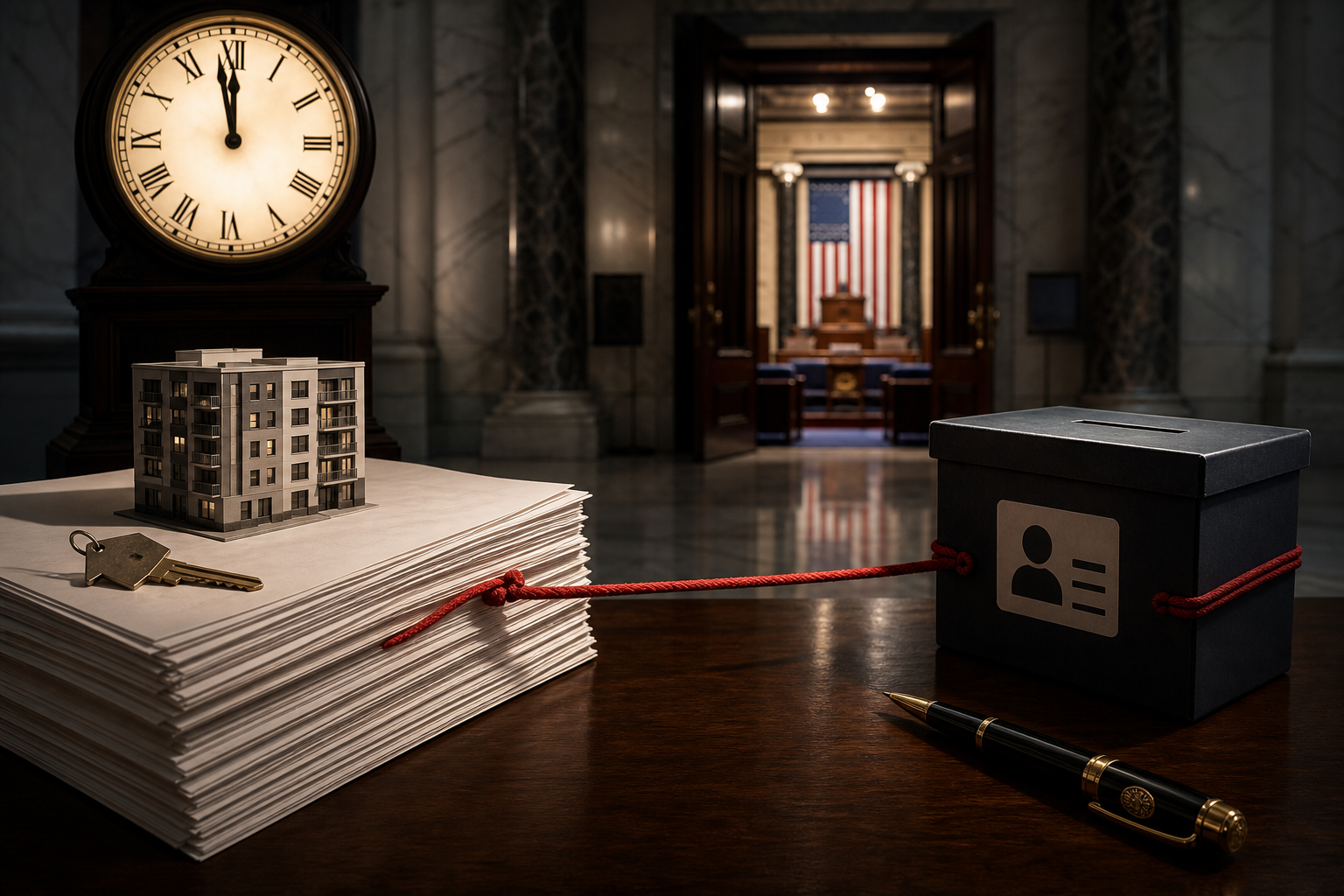
Trump Says No Signature on Housing Bill Without Voter ID
Trump’s Housing Deadline Becomes a Voter ID Test
A housing bill may become law at midnight without President Trump’s signature. Trump is trying to make voter ID the price of approval anyway.
That is the fight NPR’s report puts in focus: the housing deadline is no longer just about housing policy. It has become a test of whether a public refusal can turn an unrelated election-rules demand into congressional pressure.
The clean frame: midnight will show whether Trump’s refusal is leverage, symbolism, or the start of an implementation fight.
The Collision At Midnight
NPR reports that a major housing bill is set to become law at midnight even though Trump says he will not sign it unless Congress first passes his sweeping voter ID bill.
That condition is the key fact.
Trump is not publicly demanding a housing change as the price of his signature. The stated condition is outside the bill’s policy lane: Congress must move on voter ID first.
That turns the deadline into a pressure point. A housing measure with a reported path to law is being used to elevate an election-administration demand.
The Refusal Is Not The Legal Outcome
The confirmed fact is Trump’s public position: no signature without voter ID legislation.
The unresolved fact is what that position changes after midnight.
NPR’s report says the bill is set to become law despite the refusal. That means the next question is not whether Trump objected. It is what the official system records and enforces once the deadline passes.
The key unknowns are practical:
- Is the bill officially treated as law after midnight? - Does implementation begin or stall? - Does the White House issue a formal statement, memo, or directive? - Does Congress respond to the voter ID demand? - Do agencies proceed, pause, or seek legal guidance?
Until those answers arrive, the refusal should be read as a political act with unresolved operational consequences.
Congress Is The Target
The immediate pressure is on lawmakers.
If Trump’s condition is literal, Congress would need to pass the voter ID bill before his signature demand is satisfied. That is why the housing deadline matters politically even if the legal mechanics still need confirmation.
The strategy is simple: use urgency in one policy area to raise the cost of inaction in another.
Housing supplies the clock. Voter ID supplies the ask.
That does not mean Congress will pass the election bill. It does not prove the housing measure will be delayed, blocked, or reshaped. But it does show the White House trying to convert a must-resolve deadline into bargaining power.
Election Rules Were Already In The Frame
The voter ID demand is not landing in isolation.
NPR separately reported that Trump removed the remaining members of the bipartisan Election Assistance Commission with the midterms months away. That does not decide the housing bill fight, and it does not prove Congress will move on voter ID.
But it does sharpen the context.
Election administration is already an active front. The housing bill fight now looks less like a random add-on and more like another attempt to force election rules into the center of a separate policy deadline.
That is the strategic significance of the move.
The Evidence Checkpoint
The next checkpoint is midnight and the official record that follows.
Four signals matter most.
First, bill status: whether the housing bill is officially listed as law after midnight, and under what mechanism.
Second, White House follow-up: whether Trump’s refusal remains a public statement or becomes a formal action, memo, directive, or implementation position.
Third, congressional movement: whether lawmakers advance, schedule, or otherwise respond to the voter ID bill Trump is demanding.
Fourth, agency behavior: whether housing implementation proceeds, stalls, or triggers legal and administrative guidance.
Until then, the tightest read is this: NPR reports the housing bill is set to become law at midnight, while Trump says he will not sign unless Congress first passes sweeping voter ID legislation.
The story now turns on the first hard evidence after the deadline: whether midnight ends the housing fight or opens a new one over how much force Trump’s refusal can carry.