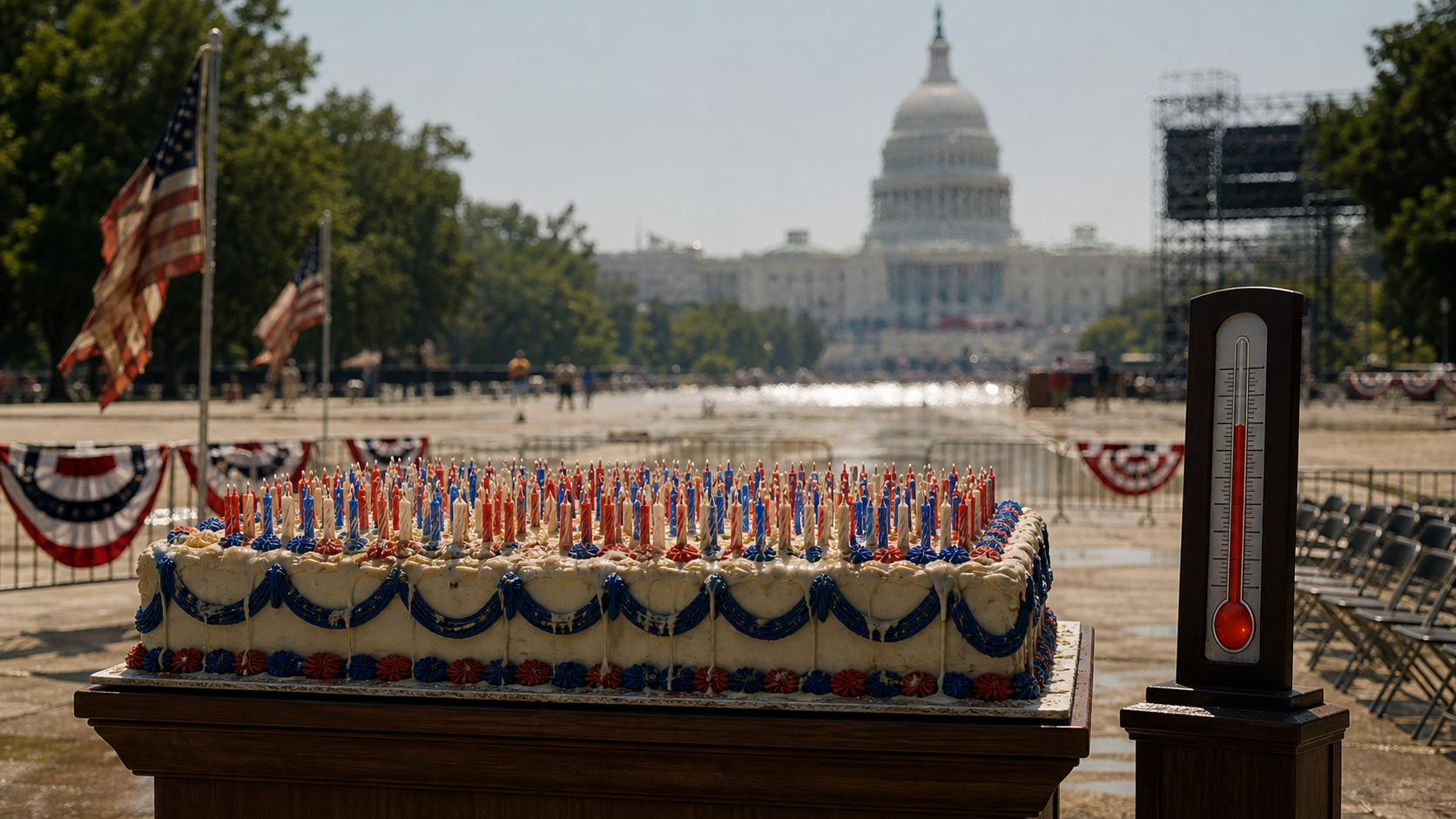
America Turns 250 Under Heat and Unease
A birthday built to unify the country is arriving as a pressure reading.
NPR’s July 4 frame for America’s 250th is not pageantry first. It is heat, worry, institutional comparison, and political contest. Severe weather may dampen Independence Day events. An NPR/PBS News/Marist poll points to anxiety about the country’s future. Other NPR reporting adds swing-voter ambivalence, questions about Congress’ founding legacy, and a fight over the America 250 celebration itself.
That is the core tension: a milestone designed for shared civic meaning is being filtered through stress.
Heat Turns Symbolism Into Logistics
The most immediate test is practical: did severe heat actually change the holiday?
NPR’s lead says July 4 celebrations may be tamped down by severe heat. That matters because weather is not just atmosphere here. It can force visible choices.
The signal to watch is simple:
- Parades shortened or moved - Outdoor ceremonies scaled back - Fireworks plans altered - Heat advisories tied to public gatherings - Public-health warnings around July 4 crowds
If those changes appear across local reporting, heat becomes the first concrete constraint on the 250th. If not, it remains part of the backdrop rather than the defining fact.
The distinction matters. A hot Independence Day is common. A national anniversary visibly reshaped by heat is a different story.
The Poll Shows Worry, Not a National Verdict
The NPR/PBS News/Marist poll gives the anniversary its mood line: worry about the country’s future.
That is enough to sharpen the frame. The 250th is not only asking Americans to look back at the Declaration. It is asking whether they trust what comes next.
But the available summary does not carry a larger conclusion by itself. The full poll details still matter: question wording, field dates, sample size, partisan mix, age breakdowns, and whether concern is rising or simply persistent.
For now, the poll supports unease. It does not prove uniform despair.
That is the more useful read anyway. Anniversary coverage often collapses into one of two easy stories: patriotic celebration or national decline. NPR’s framing lands in the harder middle: the country can still celebrate while doubting its direction.
Swing Voters Keep the Mood From Flattening
NPR’s Swing Shift reporting complicates the anxiety frame.
Some swing voters described America at 250 as “cautiously optimistic.” That phrase matters because it keeps worry from becoming a one-note story.
A voter can think the country is strained and still believe it is repairable. Concern can coexist with attachment. Doubt can coexist with patriotism.
That is the sharper political signal. The 250th is less a referendum on whether Americans still care about the country and more a referendum on whether they believe its institutions can still deliver.
Congress Becomes the Anniversary Mirror
NPR’s July 2 piece on the Second Continental Congress adds an institutional layer.
The Second Continental Congress produced the Declaration of Independence 250 years ago. That history turns today’s Congress into more than a backdrop. It becomes a comparison point.
The anniversary asks whether the institution tied to the founding moment still lives up to that inheritance.
That comparison is uncomfortable because Congress is both symbol and operator. It carries the prestige of the founding era, but it is judged by present performance: representation, lawmaking, legitimacy, and public trust.
At 250, Congress is not just part of the history lesson. It is one of the places where the meaning of the anniversary is being tested.
Freedom 250 Adds the Political Fight
The sharper partisan pressure point is the fight over the celebration itself.
NPR reported July 2 that House Democrats released a 55-page report accusing Trump and Freedom 250 of hijacking America’s birthday celebrations for profit and using questionable fundraising methods.
That allegation can reshape the anniversary story only if the follow-up evidence holds. The next layer is documentation: whether reporting substantiates the fundraising claims, shows who benefited, and captures meaningful responses from Trump, Freedom 250, or event organizers.
Without that, the controversy remains political atmosphere. With it, the 250th becomes not just a civic milestone under heat and anxiety, but another fight over legitimacy.
The Next Checkpoint Is Evidence, Not Mood
The strongest read is narrow and clear: America’s 250th is being framed as a pressure reading.
The pressure points are visible: severe heat, future-facing worry, cautious swing-voter optimism, congressional comparison, and a partisan dispute over the commemoration.
The next checkpoint is whether those pressures become measurable facts.
Did heat change events? Does the full Marist poll show broadening concern or a familiar partisan split? Do the Freedom 250 allegations produce documentation and responses?
That evidence will decide whether the 250th is remembered as a strained but normal national birthday — or as a civic milestone that revealed how much stress the celebration had to carry.