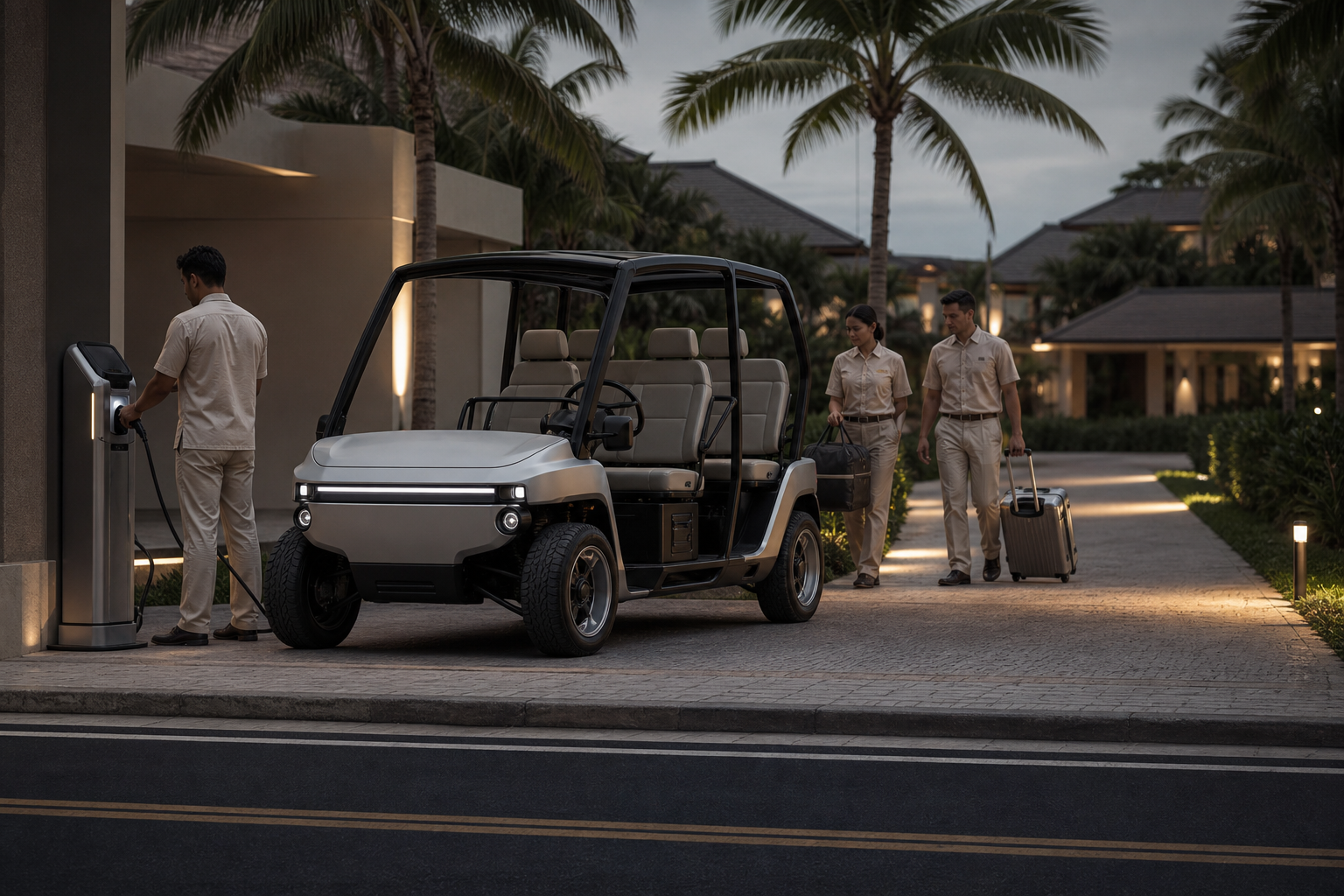
Apple and Audi Alumni Built a $25,000 Moon-Buggy EV for Resorts
A $25,000 moon buggy needs a buyer, not just a look
A $25,000 moon-buggy EV only makes sense if luxury resorts treat it as infrastructure, not decoration.
That is the real bet behind the Amble One.
Ars Technica reports that Apple and Audi alumni have built a luxe, street-legal electric buggy aimed at luxury resorts. The headline hook is the moon-buggy look. The business question is narrower: can this become a useful hospitality vehicle category, or is it a sharp concept looking for a market?
The frame is simple: the buyer test is named resorts; the operating test is street legality where those resorts actually run vehicles.
A hospitality wedge, not a consumer EV swing
The Amble One should not be read as another broad attempt to crack the consumer EV market.
Its stated target is much tighter: luxury resorts.
That changes the buying logic. A resort may care less about everyday commuter needs and more about:
- Guest transport - Grounds mobility - Quiet operation - Visual identity - Movement across mixed-use resort roads and paths - A vehicle that feels premium in guest-facing spaces
That is why the $25,000 price point matters. It is not being positioned against mass-market sedans. It is being positioned against the resort’s willingness to pay for branded mobility that also does real work.
The Apple and Audi alumni angle gives the product design credibility. But there is no basis here to treat Apple or Audi as involved companies. The relevant event is the Amble One itself: a street-legal electric buggy aimed at a specific hospitality buyer.
The silhouette gets attention; operations decide adoption
The moon-buggy comparison is doing useful launch work.
It makes the vehicle easy to picture. It gives the product a memorable shape before the market has seen much proof. It also helps explain why this story travels: alumni from design-heavy auto and tech environments build a resort EV that looks unlike the standard cart.
That is strong positioning.
It is not yet market validation.
For a resort, the vehicle cannot stop at being photogenic. It has to be safe around guests, reliable enough for repeated daily use, maintainable by an operator, and useful across the actual layout of a property.
A memorable vehicle can create guest experience value. But a fleet buyer still has to justify the purchase.
Street-legal is the hinge
The most important claim is not the moon-buggy styling. It is street legality.
That is the line between novelty cart and operational vehicle.
Resorts often involve mixed-use movement: guest areas, private roads, parking zones, grounds, access routes, and nearby public streets. If the Amble One can legally move across those boundaries, the resort use case becomes more credible.
But the claim needs detail before it can carry the full story.
The missing proof points are practical:
- Range - Top speed - Battery size - Seating layout - Safety equipment - Approved jurisdictions for road use - Delivery timing - Maintenance and support model
Street-legal in a headline is not the same as resort-ready in the field. The vehicle has to be legal where customers operate and useful enough to replace or augment what they already use.
The current proof gap is demand
The public product claim is concrete: Amble One, $25,000, street-legal, electric buggy, designed for luxury resorts.
The confidence gap is also clear.
There is not yet enough provided evidence to verify customer traction, production capacity, delivery schedule, fleet economics, or resort adoption. The available story establishes positioning more than demand.
That does not weaken the concept. It defines the next test.
A credible resort-market signal would include:
- Named luxury resort customers - Purchase commitments - Pilot deployments - Operating details from real properties - Clear production and delivery timing
Without those, the Amble One remains an attention-efficient launch: distinctive design, premium associations, and a focused buyer story.
With those, it becomes something more interesting: a small EV category built around hospitality operations.
The next checkpoint is a named deployment
The Amble One is a narrow EV bet with a clean thesis: luxury resorts may want a street-legal, visually distinctive electric buggy that works as both transport and experience infrastructure.
Now the story needs proof outside the render and the pitch.
The next evidence checkpoint is a named resort deployment with delivery timing and clarity on where the vehicle is approved for road use.
If that arrives, the moon-buggy look becomes more than launch fuel. It becomes part of a real resort mobility product.
If it does not, the Amble One risks staying where many striking mobility concepts stall: memorable shape, unclear buyer.